 ClımbSenseı
Climb Sensei
A second window for before and after your game
A small window that sits beside League on your own screen and shows you the same build advice this website does, worked out at your rank. It is something you read. It never plays for you: it presses no keys, moves no mouse, and changes nothing inside the game. Every picture below is the real app, not a drawing of one.
The line we do not cross
Written here because it is the first thing anyone should know about it.
Climb Sensei is a reference you read. It never takes an action in the game for you — no key is pressed, no mouse is moved, nothing inside League is changed or read out of its memory.
On the loading screen it looks at each enemy’s last 20 games, the same public match history anyone can look up, and tells you things like whether the champion they picked is their main. It never shows names during champion select. It does not track enemy cooldowns, it does not reveal anything hidden, and it does not try to hand you information the game has chosen not to give you.
And it does not decide for you. It offers choices, tells you how sure it is about each one, and says plainly when it is not sure at all.
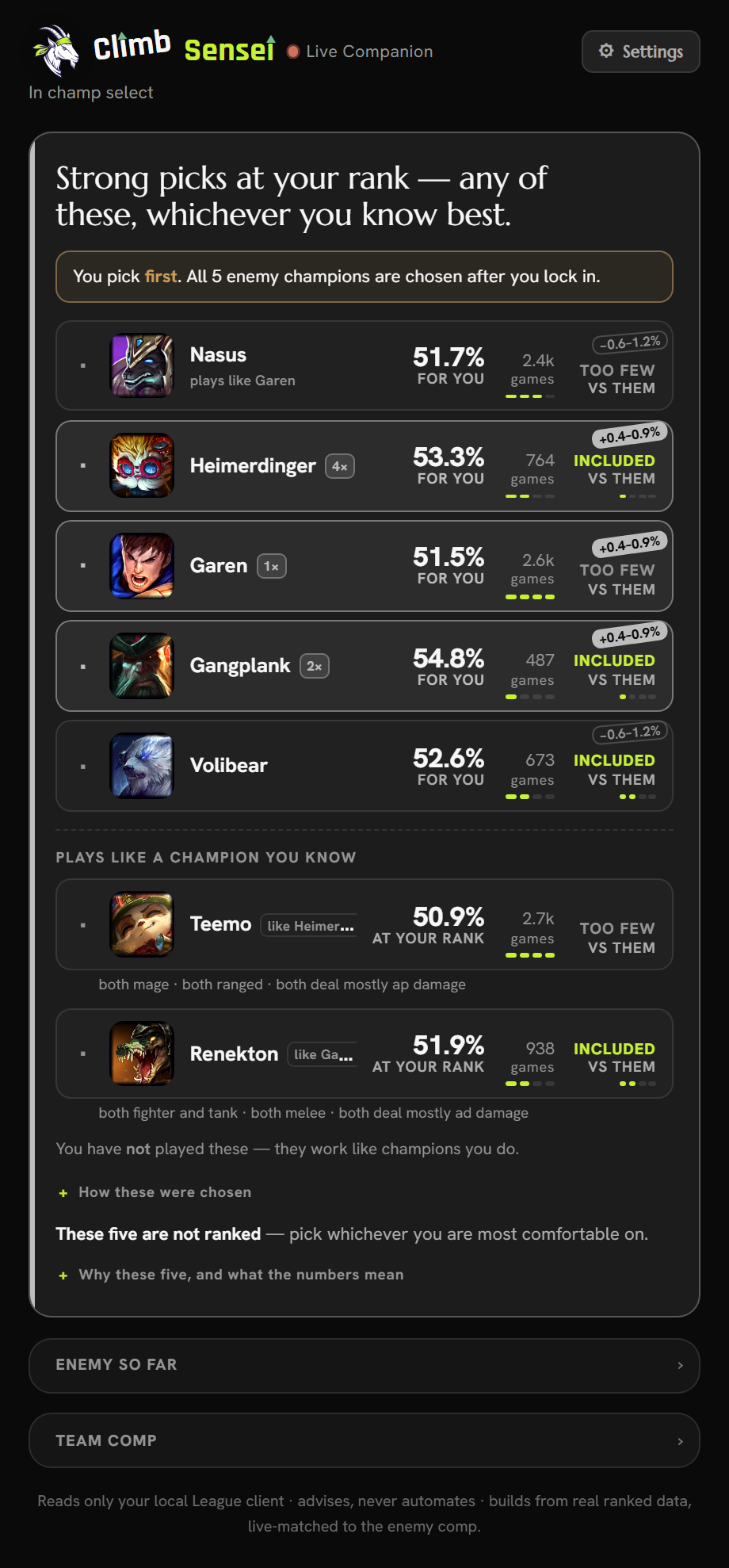
Before you lock in
Five champions that win most often in your role at your rank — with the lane you are up against, and the ones you already play, taken into account. They are listed highest win rate first — but we have not yet tested whether the top one really beats the bottom one, so until we have, the one you know best is the one to take.
The small figure in the corner of each row is the part that comes from you rather than from the champion. Play a champion often and you win a little more on it; pick one you have not touched lately and you win a little less. So a champion you already play gets a small amount added, and one that is new to you — or that you have not played in a while — gets a small amount taken away. Players do better on champions they know well. We count it as yes or no, not a bonus that keeps growing. The nudge is small on purpose: it can only move a champion past ones it was already close to, and it can never lift a weak champion into the list.
How we pick them: a champion with only a few games has its win rate pulled back toward average. So a big lead on a handful of games does not jump the queue, and one with too few games to judge is left out entirely. When we have not yet shown the list beats guessing in your exact spot, the app says so on the screen.
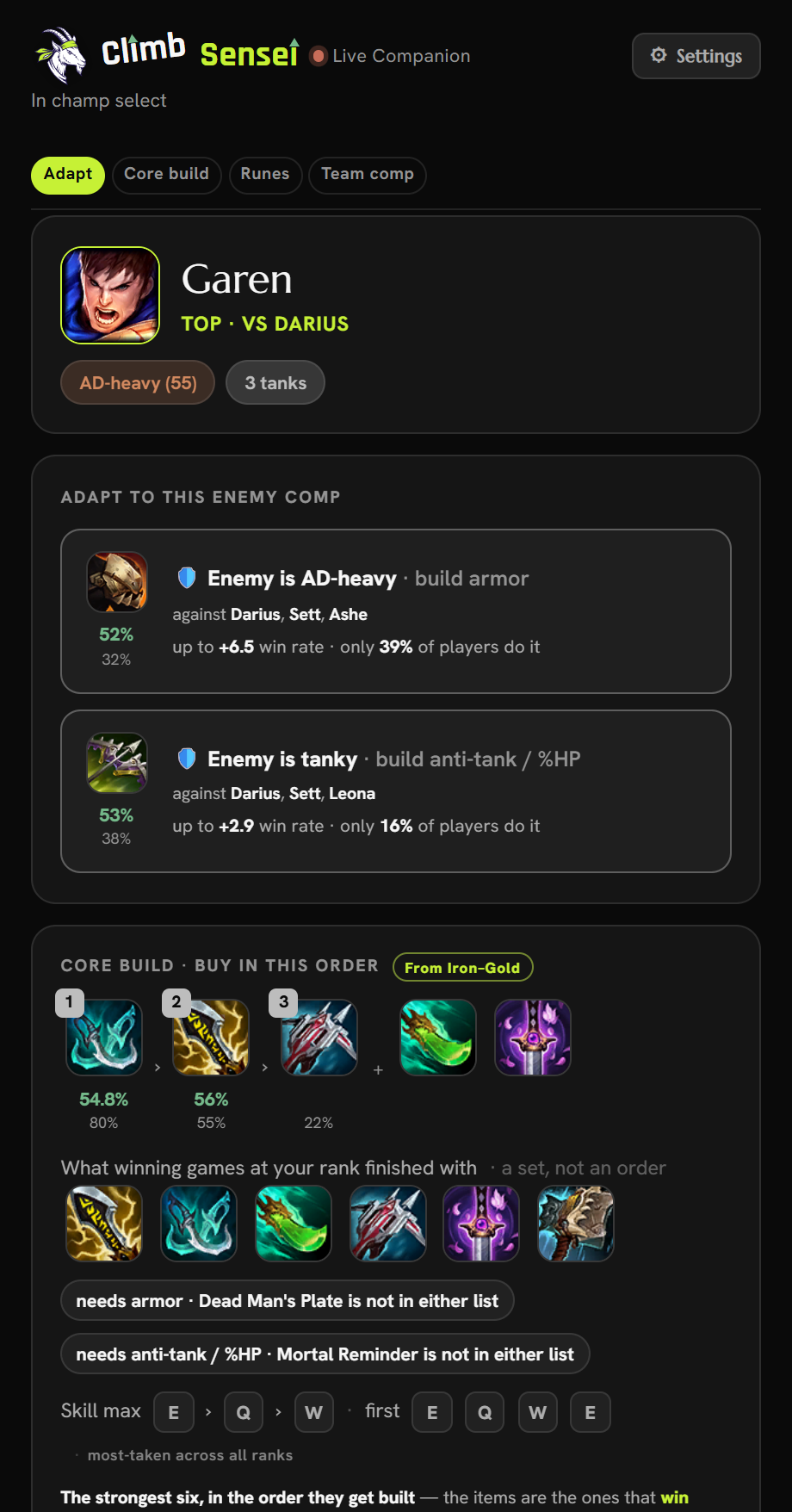
Once you have a champion
It reads the enemy team as it is drafted and says what to change because of it — then gives you your champion’s core build and the order to buy it in.
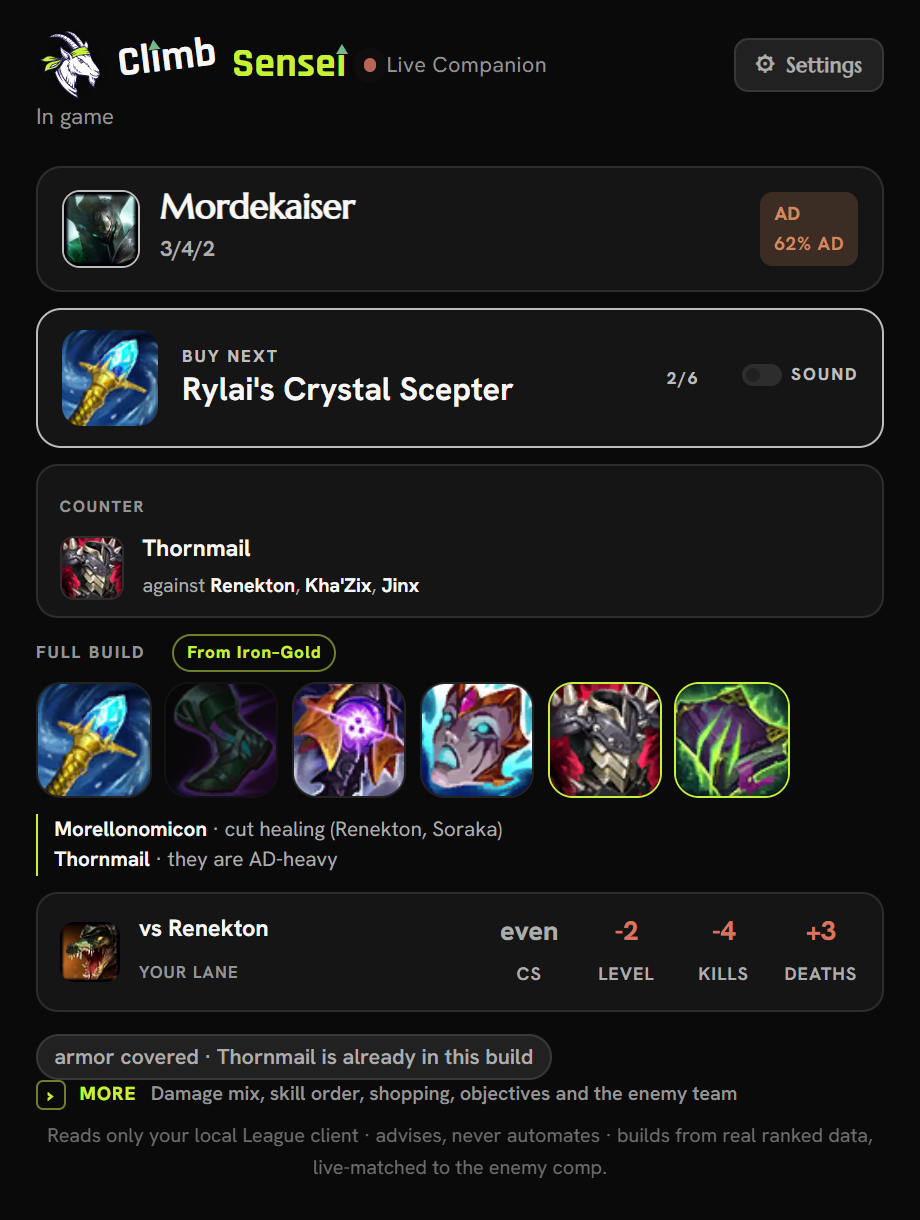
Your build, still open beside the game
Your build stays open in the window so you do not have to remember it or tab out to look it up — the next item, the rest of the order, and how your lane is going.
While you play, it reads only what League itself puts on your own screen, and it never shows you anything hidden about another player.
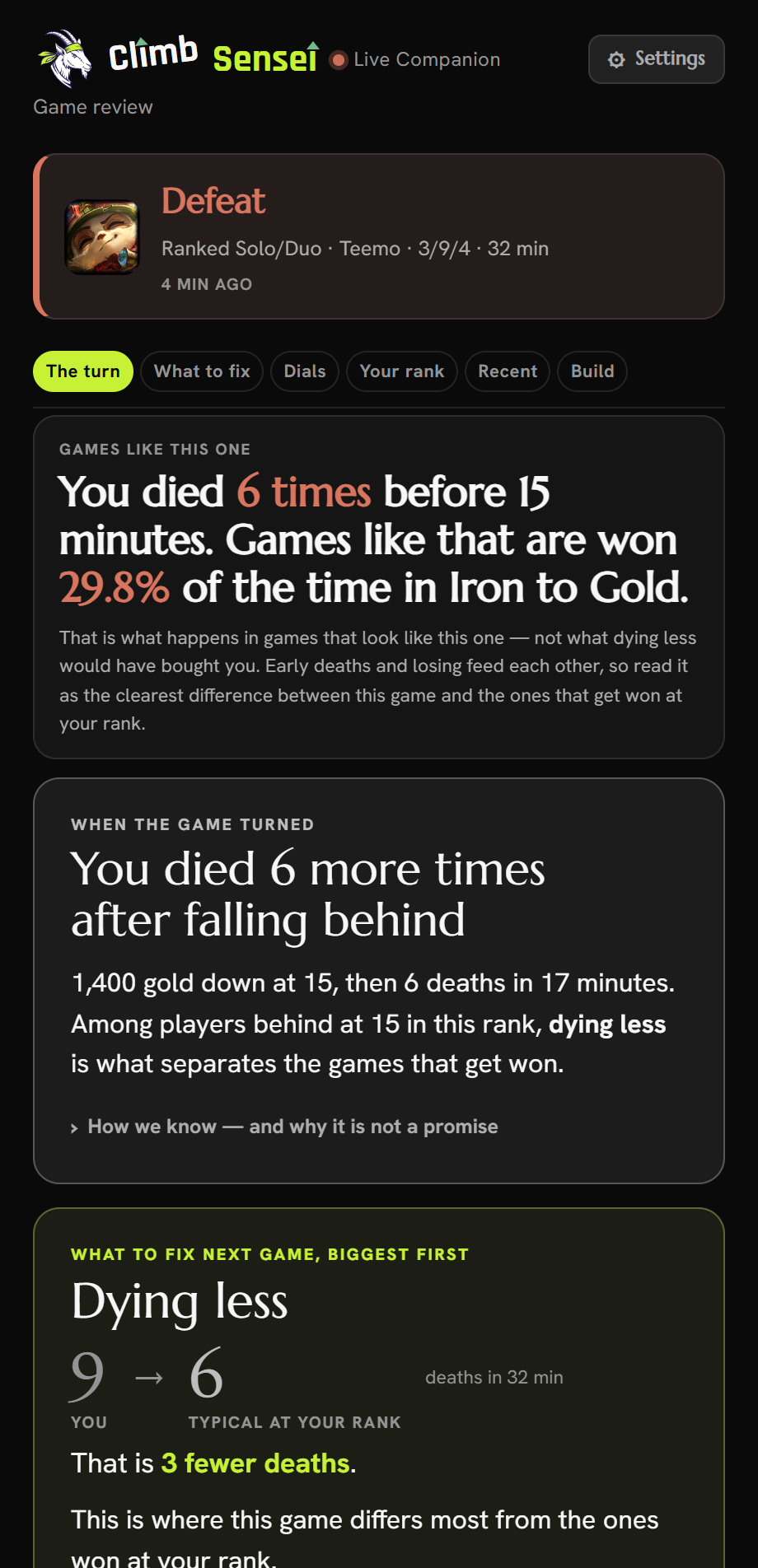
After the game
It shows what turned the game, and the one thing to fix next, so you are not handed a list of ten things.
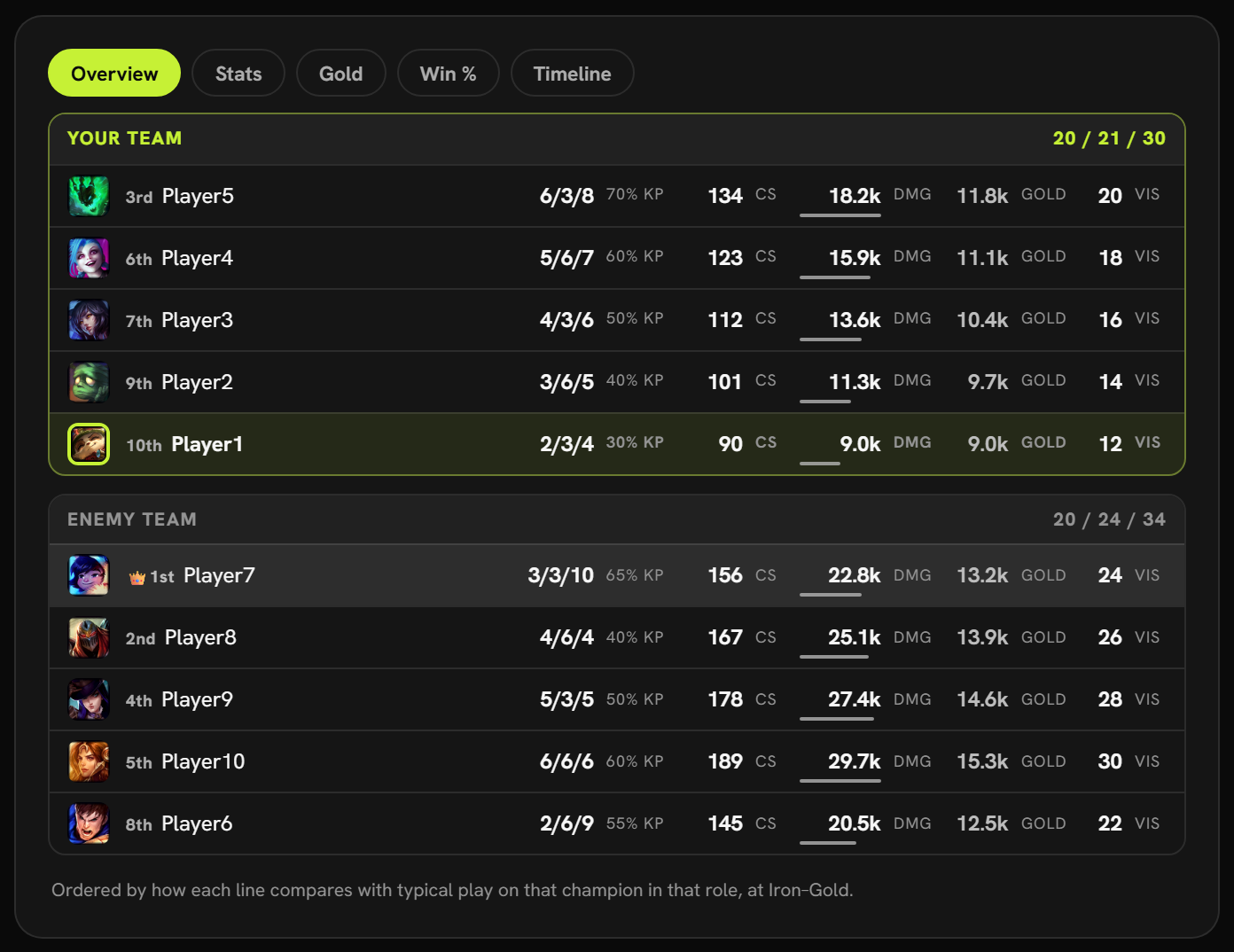
The whole scoreboard, graded
All ten players placed 1st to 10th — not against each other, but against how that champion normally does in that role at your rank. The place comes from farm, damage, vision and deaths per minute, so kills and assists do not decide it.
What you get for every player: kills, deaths and assists, share of the team’s kills, farm, damage done, gold earned and vision. Then tabs for gold over the whole game, the timeline of every kill and objective, and your team’s chance of winning as the game goes, taken from how games with about the same gold lead at about that point ended in your broad rank group. It is a rough guide. It reads too high when your support holds the gold lead. Where a number is not in the data we could get, the column is left out rather than shown blank.
What makes it different
Four things we hold ourselves to.
It never plays for you
It reads what League already puts on your screen, plus each enemy’s public match history on the loading screen, and shows advice beside it. It presses no keys, moves no mouse, and changes nothing inside the game.
It answers for your rank
Most advice is measured from the very top of the ladder and handed to everyone. Ours starts at the rank you actually play, because what wins in Iron is not what wins in Master.
It reacts to this game
Not a fixed build page you look up before you queue. It sees the five champions you are actually against and changes its answer because of them.
It admits what it does not know
When there are not enough games behind an answer, it says so on the screen instead of printing a confident number. Plenty of things we tested got cut because the number did not hold up when we checked it again.
Not out yet
The companion has been tried on real games and is still being tested. We would rather ship it late than ship it wrong, so there is no date on this page — when it is ready, it goes up here.
Want to know when? Write to admin@climbsensei.com and we will tell you. Nothing else is done with your address.
In the meantime, the site already carries the same numbers the companion uses.